
Waking Up Review
Sam Harris’s meditation app, as much a course in the nature of mind as a meditation library.
Our rating
4.5 / 5
Starting price
Free trial, then ~$99.99/yr (free if you can’t afford it)
Free tier
Yes
Platforms
iOS · Android · Web
Developer
Waking Up Course LLC
Launched
2018
Our verdict
Waking Up is the most intellectually serious meditation app available. Sam Harris’s introductory course is arguably the best on-ramp to genuine insight practice, and the theory library, talks and lessons from philosophers and teachers, has no real rival. Notably, the company gives free access to anyone who emails saying they cannot afford it.
This review is editorial and unsponsored, no affiliate payments influence our ratings. Selfpause makes a wellness app of its own, so where a product competes with us, we say so plainly and let you judge.
Waking Up is built by neuroscientist and author Sam Harris, and it refuses to treat meditation as mere stress relief. Its premise is that meditation is a tool for understanding the nature of your own mind, with calm as a side effect, not the point.
The core is Harris’s structured introductory course, which teaches mindfulness and then pushes into territory most apps never touch: the nature of consciousness, the illusion of the self, nondual awareness. Around it sits a large theory library of lessons and conversations with teachers and philosophers.
It is premium-priced, entirely secular, and unapologetically demanding. It also has the most generous access policy in the category: anyone who cannot afford it can request a free account, no questions asked.
What Waking Up looks like
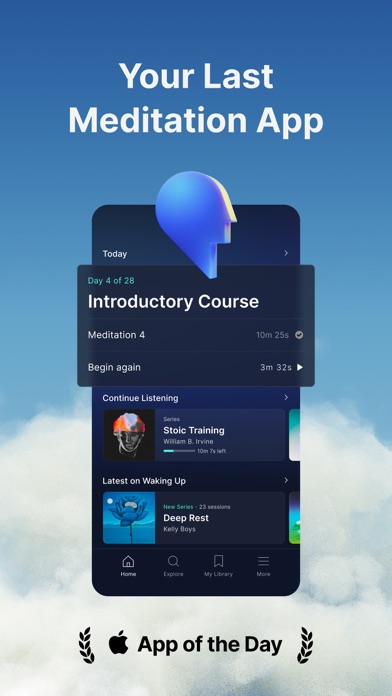


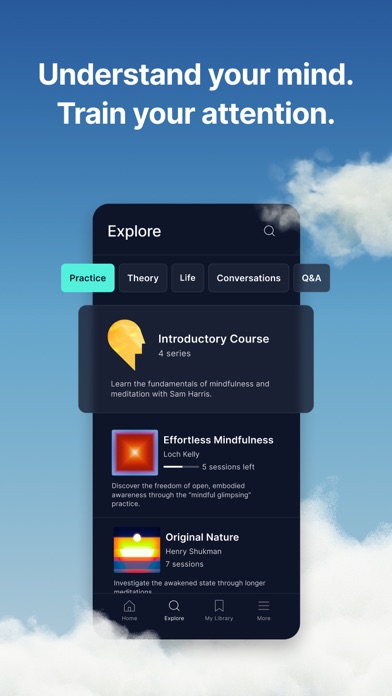

Screenshots from Waking Up’s App Store listing, © Waking Up Course LLC.
Pros & cons
What we like
- The best structured introduction to serious insight meditation.
- A theory library, talks, lessons, conversations, no competitor matches.
- Entirely secular and intellectually honest.
- Free access for anyone who emails saying they cannot afford it.
- Daily meditations that genuinely progress in depth.
What we don’t
- Premium price (~$99.99/yr) if you do pay.
- Demanding, it asks for real attention, not background listening.
- Minimal sleep or relaxation content; that is not its job.
- Harris’s voice and perspective dominate; if he grates, skip it.
Best for / avoid if
Best for
- →People who want to understand the mind, not just relax it
- →Intellectually curious skeptics and philosophy readers
- →Experienced meditators ready for nondual practice
- →Anyone priced out elsewhere, the free-access policy is real
Avoid if
- →You mainly want sleep stories and ambience, choose Calm
- →You want light, brief sessions to de-stress
- →You dislike Sam Harris, his presence is pervasive
Pricing
Free trial
$0
A sample of the introductory course and daily meditations.
Subscription
~$99.99/yr
Full course, daily meditations, and the theory library.
Free access
$0
Granted on request to anyone who cannot afford a subscription.
What Waking Up is
Waking Up is a meditation app pairing a rigorous introductory course with a deep theory library on the nature of mind, built by Sam Harris.
It is a course in awareness first and a relaxation tool a distant second, closer to a serious education than a wellness product.
Why Waking Up goes where other apps don’t
Most apps stop at calm. Waking Up starts there and keeps going, into insight practice and nondual awareness, the actual destination of the contemplative traditions mindfulness was borrowed from.
That ambition, delivered secularly and rigorously, is the entire product. For the right person it reframes what meditation is for.
The Introductory Course
A sequenced course that builds from basic mindfulness to insight practice, with theory woven through.
It is widely considered the best on-ramp to serious practice in app form, demanding, but transformative for those who finish it.
The theory library
Lessons and long-form conversations with meditation teachers, philosophers, and scholars.
This is the moat. No other app offers anything like this depth of thinking about the mind alongside the practice itself.
Where Waking Up falls behind
Relaxation content. Sleep stories and soundscapes are not what this app is for.
Lightness. If you want five casual minutes, this will feel like homework.
Voice diversity. Harris anchors everything; the app rises and falls with him for you.
Waking Up vs. Ten Percent Happier vs. Headspace
Think of it as a ladder: Headspace teaches you to meditate, Ten Percent Happier deepens it with great teachers, and Waking Up asks what the mind actually is.
Choose Waking Up if the philosophical dimension excites you. If it sounds exhausting, you will be happier, literally, with one of the other two.
And if cost is the barrier, remember Waking Up’s free-access policy makes it, paradoxically, the most accessible premium app in the category.
Bottom line
Waking Up is the deepest meditation app made, a genuine education in the mind for people who want more than stress relief. For casual calm or sleep, pick Calm or Headspace instead.
Want a daily positivity practice in your own voice? Selfpause lets you record personalized affirmations, layer them with calming music, and keep them on your lock screen.
Try Selfpause FreeAlternatives to Waking Up

Happier (Ten Percent Happier)
4.4Great teachers with a more practical, casual tone.
Read our review →

Headspace
4.5The friendliest structured on-ramp.
Read our review →

Insight Timer
4.6Endless free content across every style.
Read our review →
Frequently asked questions
Is Waking Up religious?+
No. It is rigorously secular. It draws on contemplative traditions but strips them of metaphysical claims, examining the mind from a scientific and philosophical standpoint.
Is it really free if I can’t afford it?+
Yes. The company grants free accounts to anyone who emails and says they cannot afford a subscription, no questions asked.
Is Waking Up good for beginners?+
Yes, if you are intellectually motivated, the introductory course assumes nothing. If you want light relaxation rather than a course, start elsewhere.
Waking Up or Ten Percent Happier?+
Waking Up for depth and philosophy; Ten Percent Happier for practical instruction with a lighter touch. Many serious meditators use both in sequence.
A note on mental health: apps and online services can support wellbeing, but they are not a substitute for professional care. If you are struggling, a licensed professional can help, and if you are in crisis, contact your local emergency number or, in the US, call or text 988 (Suicide & Crisis Lifeline).
More meditation apps reviews
Insight Timer
4.6The largest free meditation library in existence, more content than you could finish in a lifetime.

Calm
4.5The most polished sleep and meditation app on the market, and priced like it.
Headspace
4.5The most structured way to actually learn meditation, friendly, progressive, and beginner-proof.