
Talkiatry Review
Online psychiatry done the traditional way, employed psychiatrists, real appointments, billed to your insurance.
Our rating
4.4 / 5
Starting price
Insurance copay (in-network model)
Free tier
No
Platforms
Web · iOS · Android
Developer
Talkiatry
Launched
2020
Our verdict
Talkiatry is the most medically conventional of the online psychiatry services, full-time employed psychiatrists, proper diagnostic evaluations, and an in-network insurance model, with the ability to prescribe controlled medications where clinically appropriate. If your insurance matches, it is the closest thing to a traditional psychiatric practice delivered through a screen.
This review is editorial and unsponsored, no affiliate payments influence our ratings. Selfpause makes a wellness app of its own, so where a product competes with us, we say so plainly and let you judge.
Talkiatry built itself as a real psychiatric practice that happens to be virtual: psychiatrists and psychiatric nurse practitioners are employees rather than gig workers, initial evaluations run a full hour, and billing goes through major insurance plans rather than subscriptions.
That structure matters for scope. Because care follows a conventional medical model, Talkiatry clinicians can prescribe across the normal range, including, where appropriate and legal, controlled medications that subscription startups simply refuse to touch.
The constraint is access: you need in-network insurance and to live in a covered state, and Talkiatry treats within its scope, it refers out severe cases needing intensive care. Inside those bounds, it is the strongest psychiatry option on this list.
What Talkiatry looks like
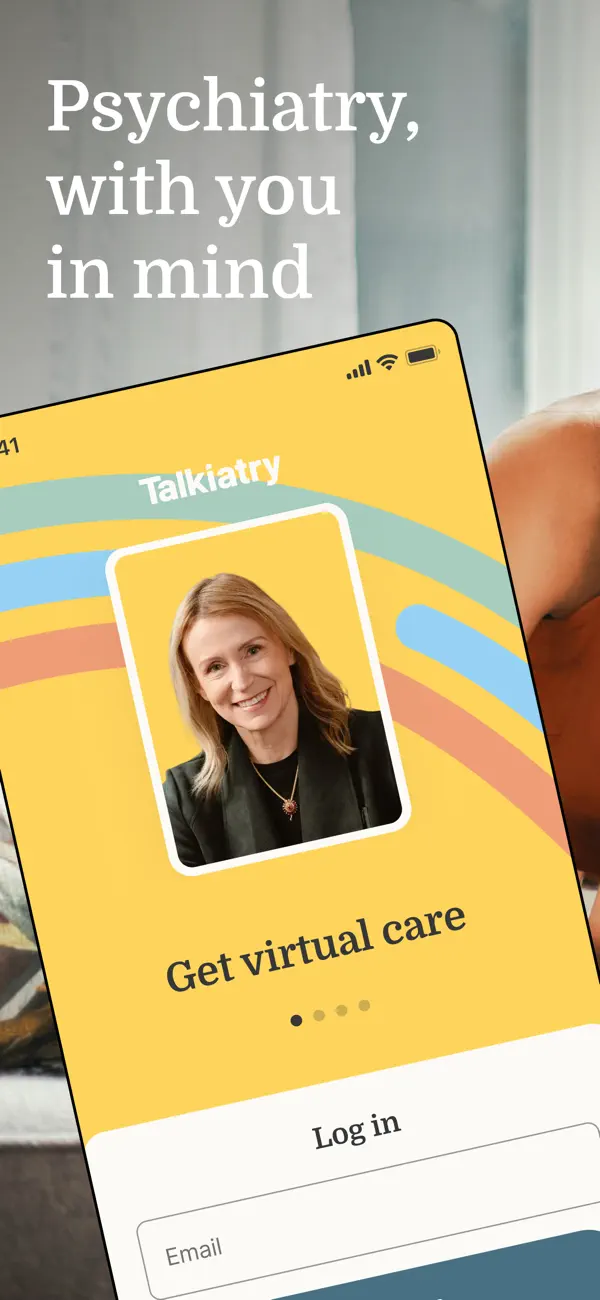

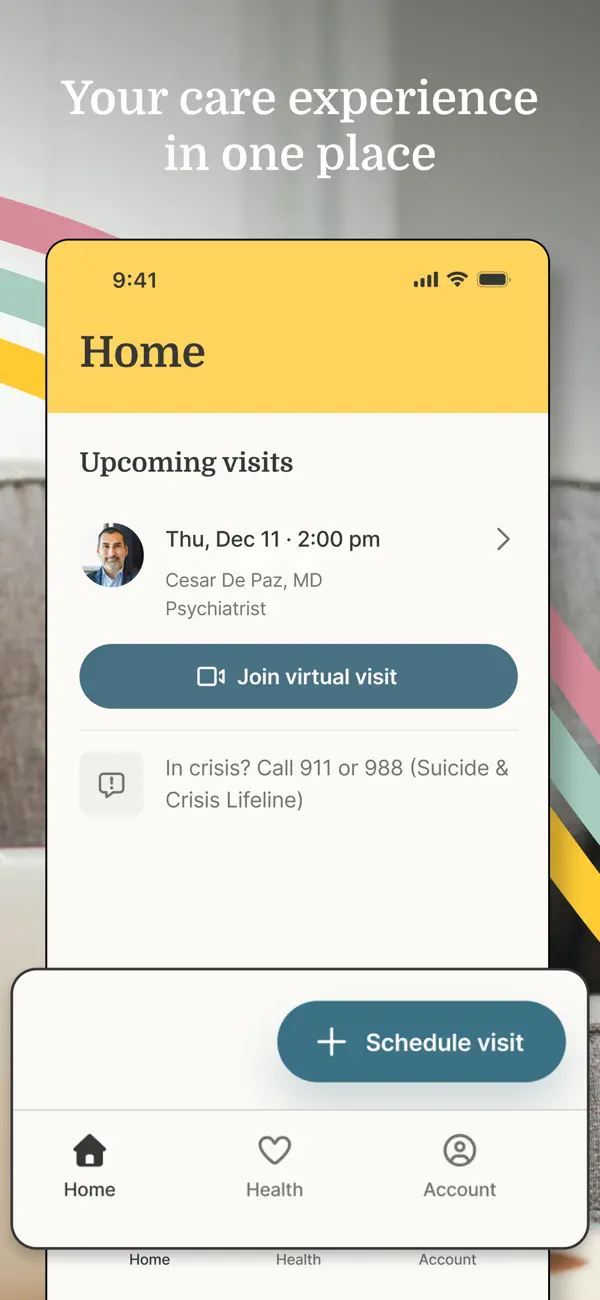
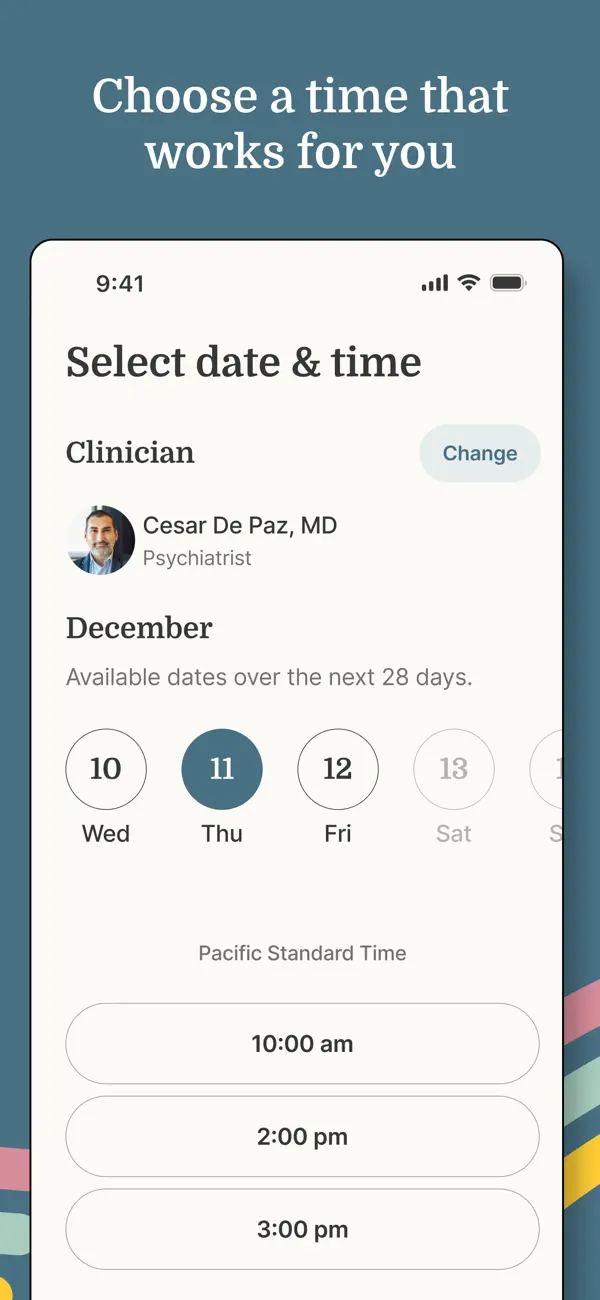
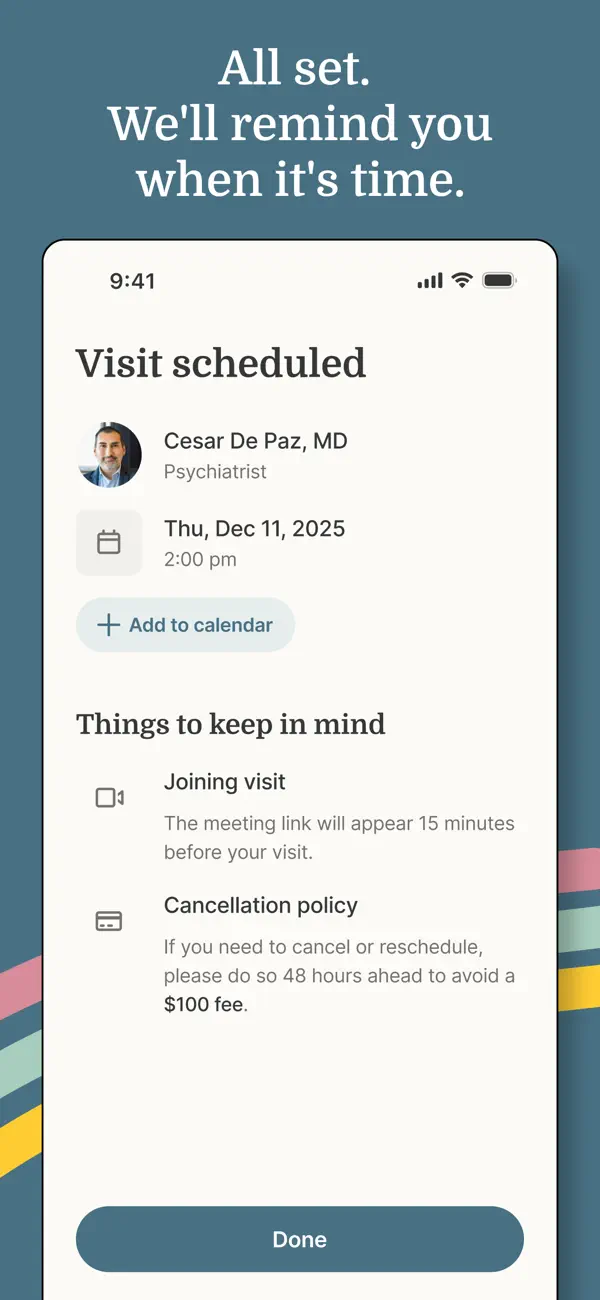
Screenshots from Talkiatry’s App Store listing, © Talkiatry.
Pros & cons
What we like
- In-network insurance model, you pay copays, not subscriptions.
- Employed psychiatrists with full-hour initial evaluations.
- Conventional prescribing scope, including controlled medications when appropriate.
- Therapy available alongside medication management.
- A medical-practice feel rather than an app-subscription feel.
What we don’t
- Requires compatible insurance, no insurance, no Talkiatry.
- Not available in every state.
- Wait times vary with psychiatrist availability.
- Refers out cases needing intensive or emergency care.
Best for / avoid if
Best for
- →People with in-network insurance seeking medication management
- →Anyone wanting a thorough diagnostic evaluation, not a questionnaire
- →Conditions like ADHD where prescribing scope matters
- →Those who want psychiatry to feel like medicine, not a subscription
Avoid if
- →You are uninsured, Brightside’s self-pay tiers fit better
- →Your insurance or state is not covered
- →You are in crisis, psychiatry services are not emergency care
Pricing
With insurance
Copay
In-network billing through major plans; verify your specific coverage during intake.
What Talkiatry is
Talkiatry is an insurance-based online psychiatry practice: evaluation, diagnosis, medication management, and therapy from employed clinicians via video.
It is virtual psychiatry on a traditional medical chassis, the opposite of the subscription-questionnaire model.
Why the employment-and-insurance model matters
Employed clinicians with longer appointments and insurance billing align incentives with care rather than volume, and allow normal prescribing judgment instead of blanket bans shaped by startup risk tolerance.
After the telehealth prescribing controversies of recent years, that conservatism is exactly what a medication relationship should be built on.
Hour-long initial evaluations
First appointments are genuine diagnostic interviews, not intake forms.
Good psychiatry starts with diagnosis; an hour with a psychiatrist is the feature everything else rests on.
Full-scope medication management
Ongoing visits adjust treatment, with prescribing scope matching conventional practice where law allows.
For conditions like ADHD this is decisive, many online services categorically will not prescribe what may be first-line.
Where Talkiatry falls behind
Access. Insurance and state coverage gate the whole service.
Speed. Matching to a psychiatrist can take longer than subscription onboarding.
Severity limits. Intensive needs are referred out, appropriately.
Talkiatry vs. Brightside vs. Cerebral
Talkiatry is the in-network medical practice; Brightside is the structured anxiety-and-depression specialist with self-pay and insurance routes; Cerebral is the subscription generalist rebuilding trust after regulatory scrutiny.
With compatible insurance, Talkiatry is the default recommendation. Without it, Brightside’s transparent self-pay tiers are the sensible alternative.
Whoever prescribes, medication decisions deserve a real diagnostic conversation, favor the service that gives you one.
Bottom line
Talkiatry is the strongest online psychiatry option for insured patients, real evaluations, employed psychiatrists, conventional prescribing. Check your coverage first; that single fact decides it.
Want a daily positivity practice in your own voice? Selfpause lets you record personalized affirmations, layer them with calming music, and keep them on your lock screen.
Try Selfpause FreeAlternatives to Talkiatry

Brightside
4.2Structured anxiety/depression care, self-pay or insurance.
Read our review →

Cerebral
3.6Subscription psychiatry with a complicated history.
Read our review →

Talkspace
4.2Therapy-first platform with psychiatry add-ons.
Read our review →
Frequently asked questions
Does Talkiatry take insurance?+
Yes, it is built on an in-network model with major plans, so you typically pay copays rather than subscription fees. Verify your specific plan during intake.
Can Talkiatry prescribe ADHD medication?+
Its clinicians prescribe within conventional medical judgment, which can include controlled medications where clinically appropriate and legally permitted, broader scope than most subscription services.
Is therapy available too?+
Yes, Talkiatry offers therapy alongside medication management, often coordinated with your psychiatrist.
What if I am uninsured?+
Talkiatry is insurance-based; uninsured patients should compare Brightside’s self-pay plans instead.
A note on mental health: apps and online services can support wellbeing, but they are not a substitute for professional care. If you are struggling, a licensed professional can help, and if you are in crisis, contact your local emergency number or, in the US, call or text 988 (Suicide & Crisis Lifeline).