
Brightside Health Review
Focused online psychiatry and therapy for anxiety and depression, structured, measured, and data-guided.
Our rating
4.2 / 5
Starting price
From ~$95/mo self-pay, or insurance
Free tier
No
Platforms
Web · iOS · Android
Developer
Brightside Health
Launched
2017
Our verdict
Brightside does one thing deliberately: medication and therapy for anxiety and depression, delivered with measurement-based care, regular symptom scoring, a data-assisted prescribing tool, and structured check-ins. It accepts many insurance plans and offers clear self-pay tiers. It does not prescribe controlled substances, so ADHD seekers should look to Talkiatry.
This review is editorial and unsponsored, no affiliate payments influence our ratings. Selfpause makes a wellness app of its own, so where a product competes with us, we say so plainly and let you judge.
Brightside narrowed the telepsychiatry problem to the two most common conditions, anxiety and depression, and built a measured pathway through them: validated symptom scales at intake and throughout, psychiatric providers for medication, therapists for skills, and plans combining both.
Its PrecisionRx-style decision support analyzes your symptom profile against outcomes data to suggest likely-fit medications, which your prescriber then exercises judgment over. Whatever one thinks of algorithms in medicine, the discipline of measurement-based care is genuinely good practice.
Boundaries are explicit: no controlled-substance prescribing, and severe or complex cases are referred to appropriate care (it also runs a dedicated crisis-care program in parts of its network). Within its lane, Brightside is a well-built, honest service.
What Brightside Health looks like
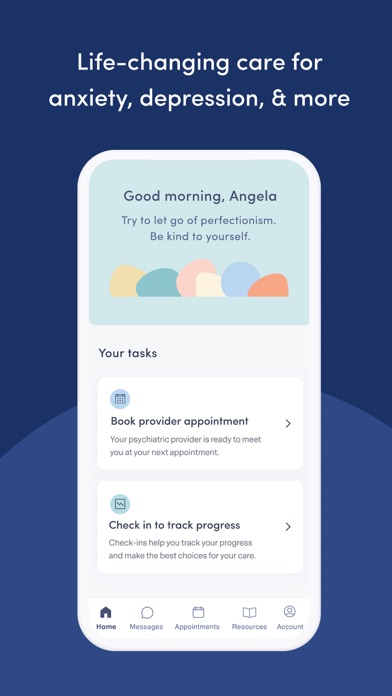
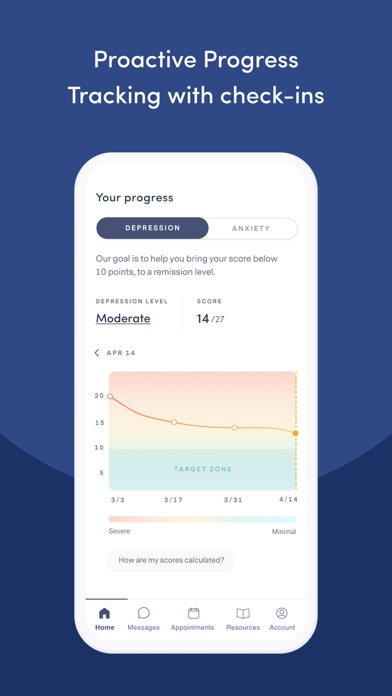

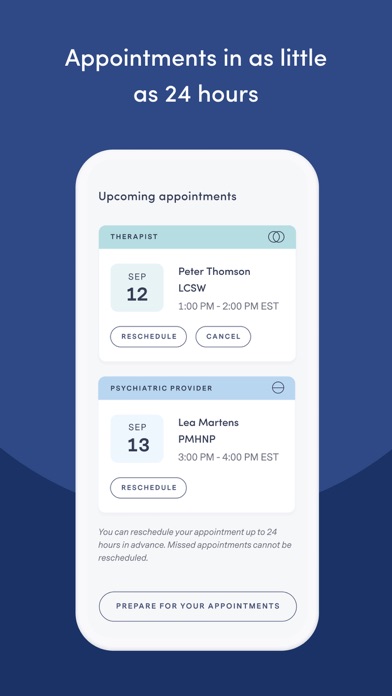
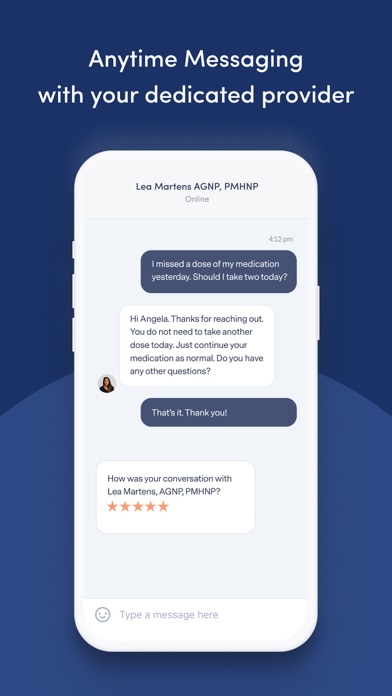
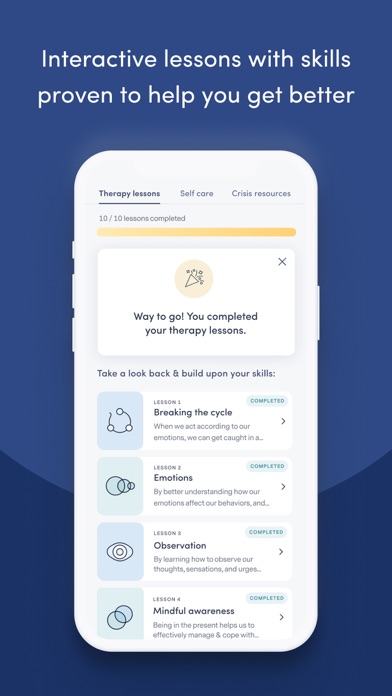
Screenshots from Brightside Health’s App Store listing, © Brightside Health.
Pros & cons
What we like
- Focused, measurement-based care for anxiety and depression.
- Both medication and therapy, alone or combined.
- Accepts many insurance plans; transparent self-pay tiers.
- Data-assisted prescribing reviewed by human clinicians.
- Regular symptom tracking makes progress visible.
What we don’t
- No controlled substances, ADHD and similar needs go elsewhere.
- Narrow condition focus by design.
- Self-pay costs add up with combined plans.
- Provider continuity can vary, as on most platforms.
Best for / avoid if
Best for
- →People seeking medication support for anxiety or depression
- →Those who want progress measured, not guessed
- →Insured patients whose plans include Brightside
- →Anyone preferring a structured program over open-ended care
Avoid if
- →You need ADHD or other controlled-substance prescribing, Talkiatry
- →Your condition falls outside anxiety/depression
- →You are in crisis, use emergency services or a crisis line
Pricing
Medication
~$95/mo + pharmacy
Psychiatric provider visits and ongoing medication management.
Therapy
~$299/mo
Weekly video sessions with messaging support.
Combined
~$349/mo
Medication plus therapy at a bundled rate; insurance can reduce all tiers.
What Brightside Health is
Brightside is an online psychiatry and therapy service specialized in anxiety and depression, built around measurement-based care and data-assisted prescribing.
It is focused telepsychiatry, narrower than a general practice, more structured than a marketplace.
Why measurement-based care matters
Most outpatient mental-health care never quantifies progress; Brightside scores symptoms continuously and adjusts treatment against the numbers, a practice associated with better outcomes and faster course correction.
The data-assisted prescribing is the visible flourish, but the steady measurement underneath is the real advantage.
Structured med + therapy plans
Choose medication, therapy, or both; check-ins and scales pace the care.
The combination plan mirrors what evidence generally favors for moderate depression and anxiety: both levers, coordinated.
Symptom tracking throughout
Validated questionnaires repeat across treatment, charting your trajectory.
Seeing the line move, or not, keeps treatment honest and reviews productive.
Where Brightside Health falls behind
Prescribing scope. The controlled-substance ban is firm.
Breadth. Outside anxiety/depression, it refers you on.
Cost. Combined self-pay approaches traditional care prices.
Brightside vs. Talkiatry vs. Talkspace
Talkiatry is the in-network full-scope practice; Talkspace is therapy-first with psychiatry attached; Brightside is the structured anxiety/depression program.
Insured with matching coverage → Talkiatry first. Anxiety/depression specifically, wanting measured structure or self-pay clarity → Brightside earns it.
For therapy-centric needs with occasional med support, Talkspace’s bundle can be the simpler home.
Bottom line
Brightside is the best structured program for medication-supported anxiety and depression care, with measurement discipline most providers lack. ADHD and broader needs belong at Talkiatry.
Want a daily positivity practice in your own voice? Selfpause lets you record personalized affirmations, layer them with calming music, and keep them on your lock screen.
Try Selfpause FreeAlternatives to Brightside Health

Talkiatry
4.4In-network psychiatry with conventional scope.
Read our review →

Talkspace
4.2Therapy-first with psychiatry add-ons.
Read our review →

Cerebral
3.6Subscription alternative with caveats.
Read our review →
Frequently asked questions
Does Brightside prescribe ADHD medication?+
No, Brightside does not prescribe controlled substances. For ADHD evaluation and conventional prescribing scope, see Talkiatry.
Does Brightside take insurance?+
Yes, many major plans are accepted, which can substantially reduce the self-pay prices listed. Verify your plan at signup.
What is PrecisionRx?+
Brightside’s decision-support tool that matches your symptom profile against outcomes data to suggest likely-fit medications, a starting point your prescriber reviews, not an automated prescription.
Therapy, medication, or both?+
Evidence often favors combining them for moderate symptoms. Brightside offers each separately and bundled; your intake assessment will recommend a starting point.
A note on mental health: apps and online services can support wellbeing, but they are not a substitute for professional care. If you are struggling, a licensed professional can help, and if you are in crisis, contact your local emergency number or, in the US, call or text 988 (Suicide & Crisis Lifeline).