
Tiimo Review
Your day as a picture, the visual planner that makes time visible for ADHD and autistic brains.
Our rating
4.2 / 5
Starting price
Free tier, then ~$54.99/yr
Free tier
Yes
Platforms
iOS · Android · Web
Developer
Tiimo ApS
Launched
2015
Our verdict
Tiimo rebuilds the daily planner around how neurodivergent brains actually process time: as color, icons, and a visual timeline you can feel passing, with widgets and gentle transitions instead of alarms and lists. Designed with and for ADHD and autistic users. It plans days, not projects, within that scope, it is the kindest scheduler made.
This review is editorial and unsponsored, no affiliate payments influence our ratings. Selfpause makes a wellness app of its own, so where a product competes with us, we say so plainly and let you judge.
Time blindness, the ADHD inability to sense duration and approach, breaks ordinary planners, whose text lists assume the very skills they demand. Tiimo’s answer is visual: your day as a colored timeline of icon-tagged activities, with progress visibly draining so "later" becomes something you can see coming.
Built in Denmark with neurodivergent users from the start, it sweats the right details: gentle pre-transition nudges rather than jarring alarms, routines you can clone, widgets that keep now-and-next on the lock screen, and zero shame mechanics anywhere.
Scope is deliberate: Tiimo structures days and routines, not projects and backlogs. Power users will pair it with a task manager; its job is making today legible, and it does that beautifully.
What Tiimo looks like


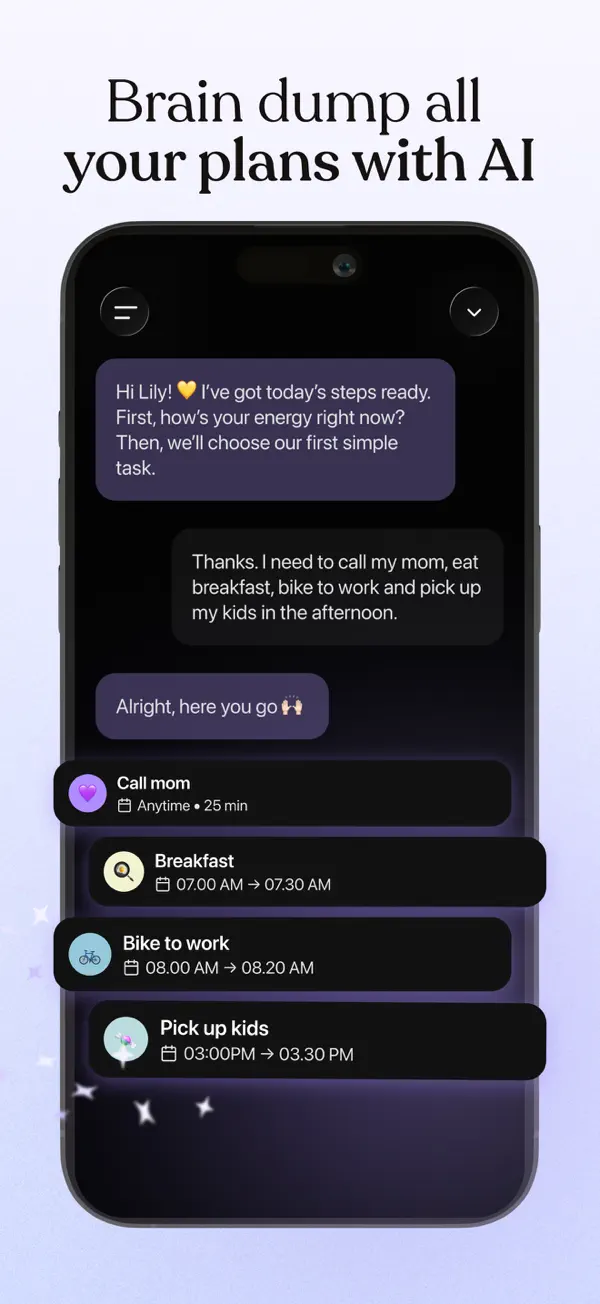

Screenshots from Tiimo’s App Store listing, © Tiimo ApS.
Pros & cons
What we like
- Visual timeline makes time genuinely perceivable.
- Designed with ADHD and autistic users, and it shows.
- Gentle transition nudges instead of alarm panic.
- Excellent widgets, now-and-next always visible.
- Routine templates remove daily replanning.
What we don’t
- Day-planning only, no project or task-manager depth.
- Subscription for full features.
- Setup investment before the magic shows.
- Icon-first style may feel playful for corporate tastes.
Best for / avoid if
Best for
- →ADHD and autistic adults (and kids) with time blindness
- →Routine-dependent days that keep dissolving
- →Visual thinkers who bounce off text lists
- →Parents structuring kids’ mornings and evenings
Avoid if
- →You need project management, pair with a task app
- →You want skills training, Inflow
- →A simple focus timer suffices, Forest
Pricing
Free
$0
Basic visual planning to start.
Premium
~$54.99/yr
Full routines, widgets, and features.
What Tiimo is
Tiimo is a visual daily planner for neurodivergent users: days as colored, icon-tagged timelines with gentle transitions, widgets, and reusable routines.
It is time made visible, scheduling for brains that cannot feel the clock.
Why visual time works for ADHD
ADHD time exists in two zones, now and not-now. A draining visual timeline drags "not-now" into view, converting abstract schedule into watchable approach.
Pre-transition nudges then solve the second failure point: switching tasks without the cliff-edge panic of an alarm.
The visual timeline
Activities as colored blocks with icons, progress draining in real time, today always glanceable.
This single view is the product, time as picture instead of promise.
Routines and widgets
Clone-able routine templates and lock-screen widgets showing now and next.
Mornings stop requiring decisions; the next right thing is simply visible.
Where Tiimo falls behind
Depth. Projects, deadlines, and backlogs live elsewhere.
Free tier. Usable but thin; the value sits in premium.
Initial setup. Routines must be built before they carry you.
Tiimo vs. Inflow vs. Forest
Tiimo structures the day, Inflow builds the skills, Forest guards a single session. Complementary layers, not rivals.
If your days evaporate, start with Tiimo; if the same patterns hurt for years, Inflow; if you just need to start one task now, Forest.
The full ADHD stack often ends up being all three.
Bottom line
Tiimo is the best visual day-planner for neurodivergent brains, time you can see, transitions you can survive. Pair it with deeper tools as needed; within its day-shaped scope, it has no equal.
Want a daily positivity practice in your own voice? Selfpause lets you record personalized affirmations, layer them with calming music, and keep them on your lock screen.
Try Selfpause FreeAlternatives to Tiimo

Inflow
4.2The ADHD skills curriculum.
Read our review →

Forest
4.3Single-session focus, gamified.
Read our review →

Fabulous
4.2Guided routine-building, neurotypical-flavored.
Read our review →
Frequently asked questions
Is Tiimo only for ADHD?+
It is designed with ADHD and autistic users centrally, but anyone who thinks visually or fights time blindness benefits, including kids, with parental setup.
Does it replace a to-do app?+
No, Tiimo plans days and routines, not projects. Many users pair it with a task manager and push today’s items into the timeline.
What does it cost?+
A basic free tier exists; full routines and widgets run about $54.99/yr.
Tiimo or Inflow?+
Different jobs: Tiimo structures today; Inflow teaches the long-term skills. Budget allowing, they stack well.
A note on mental health: apps and online services can support wellbeing, but they are not a substitute for professional care. If you are struggling, a licensed professional can help, and if you are in crisis, contact your local emergency number or, in the US, call or text 988 (Suicide & Crisis Lifeline).
