
NOCD Review
The OCD specialist, exposure and response prevention therapy delivered by trained clinicians, mostly in-network.
Our rating
4.5 / 5
Starting price
Insurance copay (widely in-network)
Free tier
No
Platforms
Web · iOS · Android
Developer
NOCD Inc.
Launched
2018
Our verdict
NOCD does one thing at scale that the general therapy market does badly: exposure and response prevention (ERP), the first-line treatment for OCD, delivered by therapists trained specifically in it, with between-session support tools and broad insurance coverage. If OCD is the problem, this is the platform, generalist therapy apps routinely mistreat it.
This review is editorial and unsponsored, no affiliate payments influence our ratings. Selfpause makes a wellness app of its own, so where a product competes with us, we say so plainly and let you judge.
OCD is among the most misunderstood conditions in therapy: standard talk therapy and reassurance often feed the disorder, while the evidence-based treatment, ERP, requires specific training many generalist therapists lack. NOCD exists because of that gap.
Every NOCD therapist is trained in ERP; sessions run by video, and the app provides structured between-session support, exposure exercises, an SOS feature for spikes, and a moderated peer community that understands intrusive thoughts without judging them.
NOCD has pursued insurance aggressively and is in-network with many major plans, making specialist care surprisingly affordable. For OCD and related conditions, it is the clearest recommendation in this entire guide.
What NOCD looks like

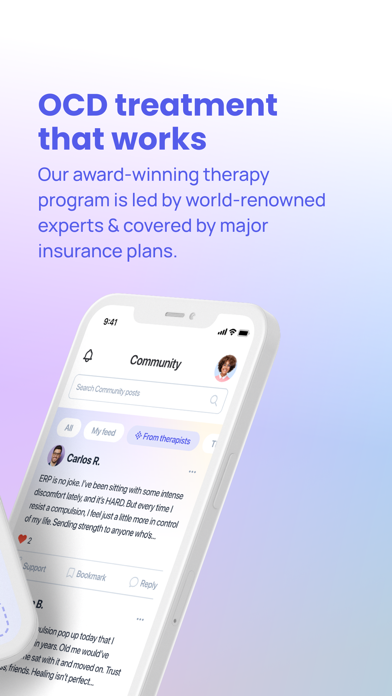
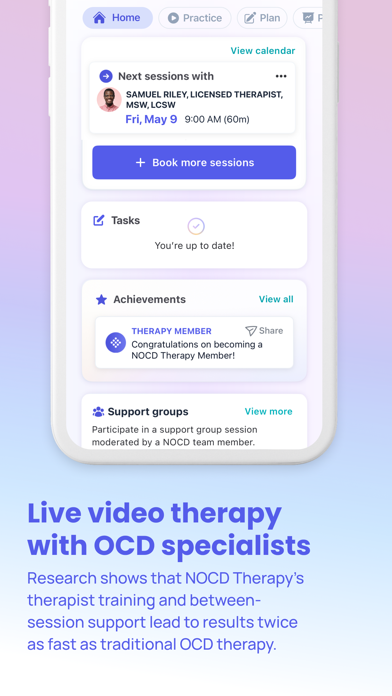
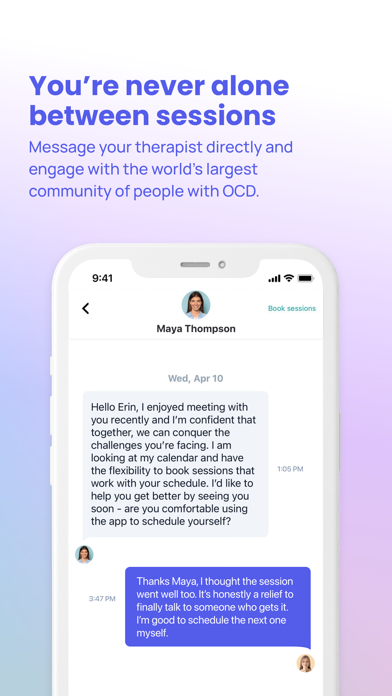
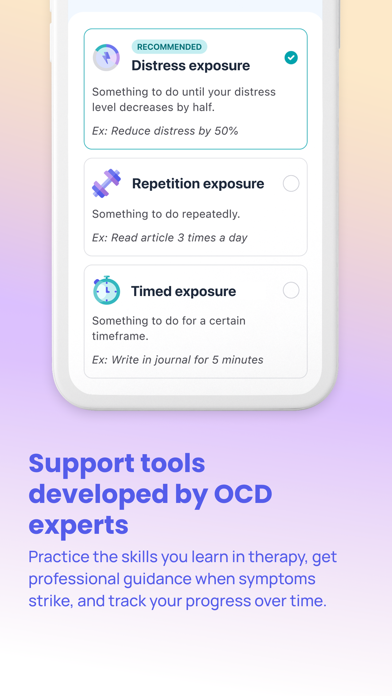
Screenshots from NOCD’s App Store listing, © NOCD Inc..
Pros & cons
What we like
- ERP, the actual first-line OCD treatment, from specifically trained therapists.
- Widely in-network with major insurance plans.
- Between-session app support: exercises, SOS tools, peer community.
- Deep familiarity with taboo intrusive-thought themes; zero judgment.
- Specialist focus avoids the harm generalist reassurance can do.
What we don’t
- OCD and related conditions only, not a general therapy platform.
- ERP is demanding; expect discomfort as part of treatment.
- Session availability varies by state and demand.
- Self-pay without insurance gets expensive.
Best for / avoid if
Best for
- →Anyone with OCD, suspected OCD, or related disorders
- →People whose talk therapy keeps circling without traction
- →Sufferers of taboo intrusive thoughts afraid to tell a generalist
- →Insured patients seeking specialist care at copay prices
Avoid if
- →Your needs are general anxiety or depression, see our therapy reviews
- →You are unwilling to do exposure work, ERP is the method
- →You are in crisis, use emergency services or a crisis line
Pricing
With insurance
Copay
In-network with many major plans, the typical route.
Self-pay
Per session
Available where coverage is absent; pricing varies.
What NOCD is
NOCD is a telehealth platform delivering exposure and response prevention therapy for OCD through specialty-trained clinicians, with app-based support between sessions.
It is specialist care for a condition generalists frequently get wrong, narrow on purpose.
Why OCD needs a specialist platform
Reassurance, the instinct of kind generalists, is fuel for OCD’s loop. ERP reverses it: graded exposure to feared thoughts while resisting compulsions, until the alarm extinguishes. Training in this is non-negotiable.
NOCD industrialized that training and paired it with insurance access, turning the right treatment from a lucky find into a default.
ERP-trained therapy via video
Structured sessions build exposure hierarchies tuned to your obsessional themes.
Theme fluency matters enormously here, NOCD therapists have seen your worst thought before, whatever it is.
Between-session support
The app carries exposures, response-prevention logging, SOS guidance for spikes, and a moderated community.
OCD attacks between appointments; treatment that lives in your pocket meets it there.
Where NOCD falls behind
Generality. It is not for non-OCD needs, by design.
Comfort. ERP works through voluntary discomfort, no way around that.
Coverage gaps. Self-pay specialist care costs real money where insurance lapses.
NOCD vs. general therapy platforms
BetterHelp or Talkspace can match you with someone kind within days, but kindness without ERP training often worsens OCD via reassurance cycles.
If OCD is even suspected, start specialist: NOCD’s assessment will clarify, and proper ERP from session one beats months of well-meaning circling.
For everything else, the generalist platforms remain the right aisle.
Bottom line
NOCD is the definitive online option for OCD, right treatment, trained clinicians, insurance access, and tools that fight the disorder where it lives. The strongest single recommendation in this guide, for exactly one condition.
Want a daily positivity practice in your own voice? Selfpause lets you record personalized affirmations, layer them with calming music, and keep them on your lock screen.
Try Selfpause FreeAlternatives to NOCD

Talkspace
4.2For non-OCD therapy needs with insurance.
Read our review →

BetterHelp
4.2General teletherapy at scale.
Read our review →

DARE
4.4Self-help for anxiety and panic alongside care.
Read our review →
Frequently asked questions
What is ERP?+
Exposure and response prevention, the first-line OCD treatment, where you face feared thoughts or situations in graded steps while resisting compulsions, until anxiety extinguishes. It requires specific therapist training.
Does NOCD take insurance?+
Yes, broad in-network coverage with major plans is central to its model, often reducing specialist care to copays.
My thoughts are too disturbing to say aloud. Is that a problem?+
No. Taboo intrusive thoughts, harm, sexual, religious themes, are textbook OCD presentations NOCD therapists treat daily. Having them treated as ordinary symptoms is often the first relief.
NOCD or a regular therapist?+
For OCD, a trained ERP specialist, at NOCD or elsewhere, beats an untrained generalist regardless of warmth. Reassurance-based talk therapy can actively entrench the disorder.
A note on mental health: apps and online services can support wellbeing, but they are not a substitute for professional care. If you are struggling, a licensed professional can help, and if you are in crisis, contact your local emergency number or, in the US, call or text 988 (Suicide & Crisis Lifeline).
More online therapy reviews
BetterHelp
4.2The world’s largest online therapy platform, convenient, flexible, and out-of-pocket.
Talkspace
4.2The online therapy platform that actually takes insurance, and offers psychiatry too.
Online-Therapy.com
4.1Teletherapy with a spine, a complete CBT program with worksheets wrapped around your live sessions.