
Modern Health Review
The coaching-forward employer benefit, one platform for therapy, coaching, group Circles, and self-care.
Our rating
4.2 / 5
Starting price
Free through participating employers
Free tier
Yes
Platforms
Web · iOS · Android
Developer
Modern Health
Launched
2017
Our verdict
Modern Health bets that most employees need support before they need therapy: certified coaches handle growth and stress, therapists handle clinical needs, Circles offer drop-in group sessions, and a meditation library covers daily maintenance. The stepped model stretches employer dollars and reduces stigma, though employees who specifically want therapy should say so plainly to skip the coaching funnel.
This review is editorial and unsponsored, no affiliate payments influence our ratings. Selfpause makes a wellness app of its own, so where a product competes with us, we say so plainly and let you judge.
Modern Health structures its benefit as a pyramid: self-guided content at the base, one-on-one coaching in the middle, licensed therapy at the top, with group "Circles" running alongside. An intake suggests your level; you move between them as needs change.
The coaching emphasis is deliberate. Much workplace distress, burnout, confidence, conflict, transitions, sits below clinical thresholds, and a good coach addresses it without the gravity of therapy. Coaching also carries less stigma in cultures where "therapy" is a heavy word, which matters for the global workforces Modern Health serves.
Critics note the same design can under-serve people who genuinely need therapy by routing them to coaching first. The platform has matured here, but be direct in your intake if therapy is what you want.
What Modern Health looks like

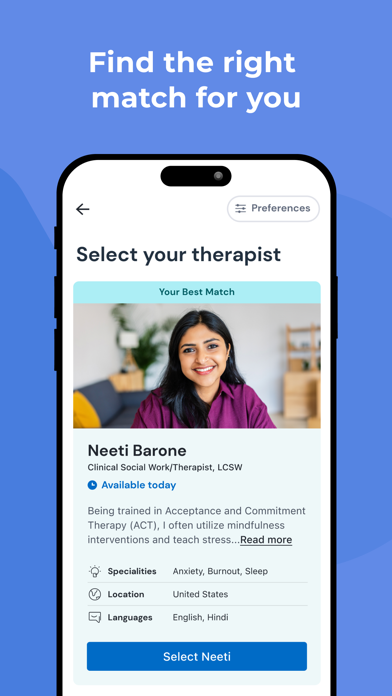
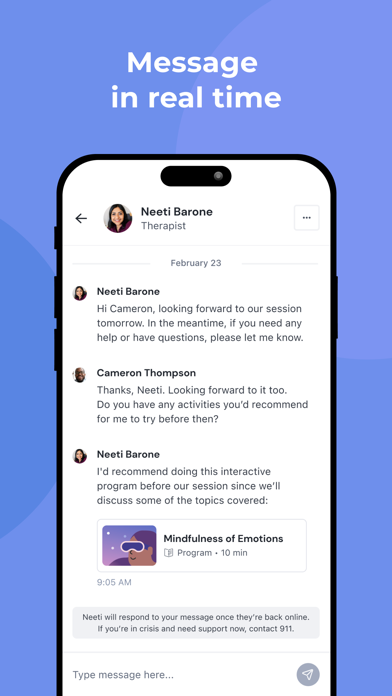


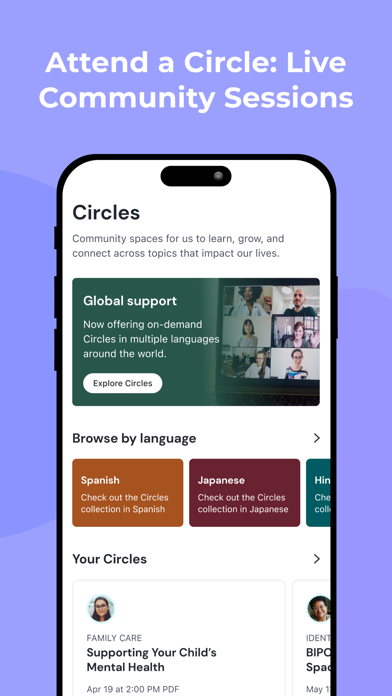
Screenshots from Modern Health’s App Store listing, © Modern Health.
Pros & cons
What we like
- Stepped care: self-serve, coaching, therapy, and groups in one benefit.
- Coaching layer fits sub-clinical needs most benefits ignore.
- Circles, drop-in group sessions on grief, burnout, identity, and more.
- Strong global and culturally aware provider coverage.
- Free to covered employees, dependents often included.
What we don’t
- Coaching-first routing can delay wanted therapy, be explicit.
- Therapy session banks can be leaner than Lyra’s, contract-depending.
- Employer-only access.
- Experience varies with your company’s configuration.
Best for / avoid if
Best for
- →Employees dealing with burnout, stress, or growth goals
- →Global teams needing culturally matched providers
- →People who prefer coaching’s framing to therapy’s
- →Group-session fans, Circles are underrated
Avoid if
- →You know you need clinical therapy, say so, or use insurance routes
- →Your employer does not offer it
- →You are in crisis, use emergency services or a crisis line
Pricing
Through employer
Free to you
Coaching and therapy sessions per your company’s plan, plus Circles and self-guided content.
What Modern Health is
Modern Health is an employer wellbeing benefit offering stepped care, self-guided programs, certified coaching, licensed therapy, and group Circles, through one platform.
It is the coaching-forward interpretation of workplace mental health: meet most needs below the clinical line, escalate the rest.
Why the coaching layer earns its place
Therapy networks drown when every stressed employee books clinical care; coaching absorbs the enormous middle, real struggles that are not disorders, with practitioners built for exactly that.
For employees, the practical win is access without self-diagnosis: you do not need to decide you are "sick enough" to get skilled help.
Stepped care model
Intake suggests self-care, coaching, or therapy; movement between levels is fluid.
Right-sized support, faster, provided you advocate when the suggestion feels wrong.
Circles group sessions
Provider-led drop-in groups on themes like burnout, parenting, grief, and identity.
Hearing colleagues-of-circumstance name your exact struggle is its own intervention, and Circles cost employees nothing extra.
Where Modern Health falls behind
Therapy directness. The funnel frustrates those who arrived knowing.
Depth per dollar. Heavy clinical needs may outrun typical session allotments.
Access. Employer-gated, as with the whole category.
Modern Health vs. Lyra vs. Spring Health
Lyra optimizes the therapy network, Spring the matching, Modern Health the sub-clinical middle. All three are free to covered employees and far better than the EAPs they replaced.
You use what your employer bought; the practical advice is identical everywhere, take the intake honestly, state your preference plainly, and escalate if under-served.
For HR buyers, workforce shape decides: coaching-receptive global teams suit Modern Health especially well.
Bottom line
Modern Health is the best coaching-forward employer benefit, a stepped model that meets the realistic spread of workplace needs. Therapy-certain employees should just say so up front.
Want a daily positivity practice in your own voice? Selfpause lets you record personalized affirmations, layer them with calming music, and keep them on your lock screen.
Try Selfpause FreeAlternatives to Modern Health

Lyra Health
4.4Therapy-network benchmark.
Read our review →

Spring Health
4.3Precision-matching rival.
Read our review →

Headspace
4.5If your benefit is meditation-only.
Read our review →
Frequently asked questions
Coaching or therapy, which will I get?+
An intake suggests a starting level, but you can state a preference. If you want therapy specifically, say so explicitly, the system respects directness.
What are Circles?+
Provider-led group sessions on themes like burnout, grief, and parenting that any covered employee can join, one of the platform’s best and least-known features.
Is it confidential?+
Yes, employers see aggregate usage only, never individual content or attendance.
Modern Health or Lyra?+
Whichever your employer provides. Lyra leans clinical-network strength; Modern Health leans coaching breadth. Both beat retail by miles.
A note on mental health: apps and online services can support wellbeing, but they are not a substitute for professional care. If you are struggling, a licensed professional can help, and if you are in crisis, contact your local emergency number or, in the US, call or text 988 (Suicide & Crisis Lifeline).