
CBT Thought Diary Review
The thought record, perfected, CBT’s single most useful exercise as a fast, well-built app.
Our rating
4.2 / 5
Starting price
Free, then ~$39.99/yr
Free tier
Yes
Platforms
iOS · Android
Developer
Moodtools / Thought Diary
Launched
2017
Our verdict
CBT Thought Diary does one thing with real care: the thought record, catch the thought, name the distortion, weigh the evidence, reframe. Guided flows make the classic exercise fast enough to use mid-spiral, with mood tracking and journaling around it. Narrower than Sanvello, deeper at its one thing than almost anyone.
This review is editorial and unsponsored, no affiliate payments influence our ratings. Selfpause makes a wellness app of its own, so where a product competes with us, we say so plainly and let you judge.
If CBT has a single load-bearing exercise, it is the thought record. This app builds itself entirely around doing that exercise well: a guided flow takes you from triggering situation through emotion, automatic thought, cognitive distortions, evidence for and against, to a balanced reframe.
The craft shows in pace, entries are quick enough to complete during the anxious moment itself, which is when reframing earns its keep. A distortion reference, mood check-ins, gratitude prompts, and history views complete the kit.
It is deliberately narrow: no courses, no meditations, no community. As the dedicated tool for CBT’s core skill, used solo or as therapy homework, it is excellent.
What CBT Thought Diary looks like
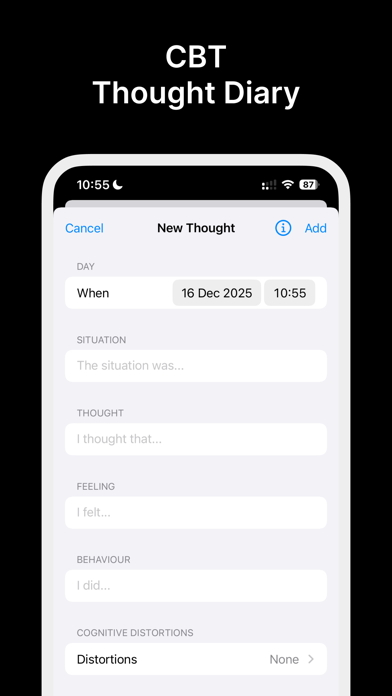
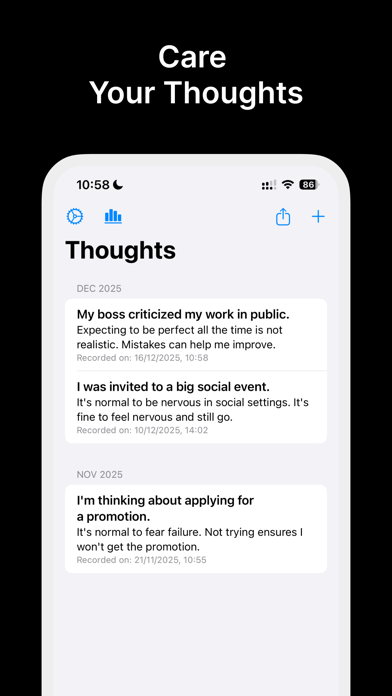

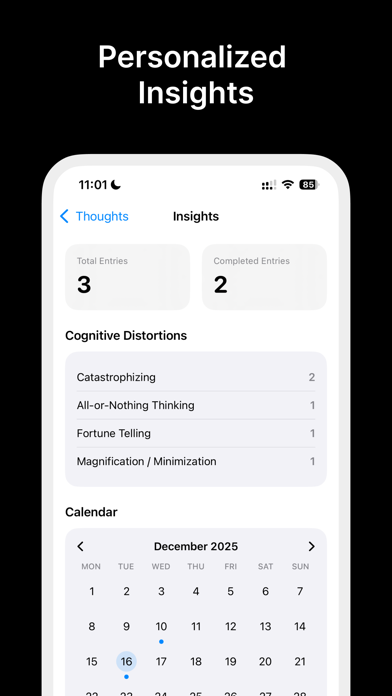
Screenshots from CBT Thought Diary’s App Store listing, © Moodtools / Thought Diary.
Pros & cons
What we like
- The best guided thought-record flow in any app.
- Fast enough to use during the moment, not after it.
- Built-in distortion guide teaches as you go.
- Clean history makes patterns and progress visible.
- Strong free tier; cheap premium.
What we don’t
- Single-exercise focus, no broader program.
- No audio, community, or coaching layers.
- Long-term analytics are basic.
- Therapy-homework feel won’t suit everyone.
Best for / avoid if
Best for
- →Anyone whose therapist assigns thought records
- →Self-helpers wanting CBT’s core skill without a full program
- →Overthinkers who need a mid-spiral circuit breaker
- →Minimalists who prefer one tool done well
Avoid if
- →You want a full toolkit, Sanvello
- →You want anxiety-specific programs, MindShift or DARE
- →You want guidance with a face or voice, Bloom
Pricing
Free
$0
Core thought records and mood tracking.
Premium
~$39.99/yr
Unlimited history, extra exercises, and export.
What CBT Thought Diary is
CBT Thought Diary is a focused app for the cognitive-restructuring thought record: guided capture, distortion identification, evidence weighing, and reframing, with light mood tracking.
It is CBT’s sharpest tool, sharpened, not a program, a practice.
Why the thought record deserves its own app
Cognitive restructuring is the exercise with CBT’s deepest evidence, and it lives or dies on being done in the moment, repeatedly. A dedicated, fast flow beats the same worksheet buried three menus deep in a mega-app.
Repetition builds the reflex, eventually you catch and reframe without the phone, which is the entire point.
Guided thought records
Step-by-step: situation, emotion and intensity, automatic thought, distortions, evidence, reframe.
The sequencing teaches the skill while applying it, scaffolding that gradually becomes unnecessary.
Distortion library and history
A plain-language guide to the classic distortions, plus searchable entry history.
Re-reading old spirals already reframed is quietly one of the most encouraging features in any CBT app.
Where CBT Thought Diary falls behind
Breadth. One exercise, however central, is still one exercise.
Engagement aids. No streak pets or videos to keep the reluctant going.
Analytics. Pattern detection stays manual.
CBT Thought Diary vs. MindShift vs. Sanvello (discontinued)
MindShift is the free anxiety program, Sanvello the broad toolkit, Thought Diary the single sharpened instrument.
For therapy homework or self-taught restructuring, the dedicated flow here is the best version. For programs and variety, the other two carry more.
They stack naturally: many people run Thought Diary inside whichever bigger system they use.
Bottom line
CBT Thought Diary is the definitive thought-record app, fast, faithful, cheap. Narrow by design, and within its lane, the best.
Want a daily positivity practice in your own voice? Selfpause lets you record personalized affirmations, layer them with calming music, and keep them on your lock screen.
Try Selfpause FreeAlternatives to CBT Thought Diary

MindShift CBT
4.3Free, broader anxiety-focused CBT.
Read our review →

Bloom
4.1Video-guided CBT for the disengaged.
Read our review →
Frequently asked questions
What is a thought record?+
CBT’s core exercise: capture an automatic negative thought, identify its distortions, weigh evidence for and against, and write a balanced reframe. Practiced repeatedly, it changes default thinking patterns.
Is this app enough by itself?+
For learning and practicing cognitive restructuring, yes. For a full program around anxiety or depression, pair it with MindShift, Sanvello, or therapy.
Is it free?+
The core experience is free and genuinely usable; premium (~$39.99/yr) adds unlimited history and extras.
Will my therapist approve?+
Almost certainly, it digitizes the exact homework most CBT therapists assign, with exportable entries to bring to session.
A note on mental health: apps and online services can support wellbeing, but they are not a substitute for professional care. If you are struggling, a licensed professional can help, and if you are in crisis, contact your local emergency number or, in the US, call or text 988 (Suicide & Crisis Lifeline).