How Changing Your Self-Talk Can Improve Performance by 25%
The Voice in Your Head Is Your Greatest Coach — Or Your Worst Critic
Every day, you have somewhere between 12,000 and 60,000 thoughts. According to research from the National Science Foundation, roughly 80% of those thoughts are negative, and 95% are the same thoughts you had yesterday.
That means most people are running a loop of repetitive, negative self-talk — and it's directly undermining their performance in every area of life.
What the Research Shows
A meta-analysis published in Perspectives on Psychological Science examined 37 studies on self-talk and performance. The findings were striking: positive self-talk improved task performance across the board, with the most significant gains showing up in precision-based tasks and high-pressure situations.
Athletes who replaced critical self-talk ("don't mess up") with instructional or motivational self-talk ("stay focused," "I've trained for this") showed performance improvements averaging 25% in competition settings.
But this isn't just about sports.
Self-Talk in the Workplace
A study from the University of Michigan found that people who referred to themselves by name or in the third person during self-talk ("You've got this, Sarah") performed better under social stress than those who used first-person ("I've got this"). This small linguistic shift created enough psychological distance to reduce anxiety and improve clarity.
In workplace settings, employees who practiced constructive self-talk before presentations, negotiations, and difficult conversations reported higher confidence, clearer thinking, and better outcomes than those who either engaged in negative self-talk or no conscious self-talk at all.
The Three Types of Performance Self-Talk
Not all self-talk serves the same purpose. Understanding the types helps you deploy the right one at the right time.
Instructional Self-Talk
This is task-specific guidance you give yourself. A surgeon might think "steady hands, focus on the incision." A salesperson might remind themselves "listen first, then respond." This type works best for tasks requiring precision and technical skill.
Motivational Self-Talk
This is about energy and belief. "I can do this." "I'm ready." "Bring it on." Motivational self-talk is most effective for endurance tasks, high-pressure moments, and situations where confidence matters more than technique.
Reframing Self-Talk
This is the most sophisticated type. It takes a negative interpretation and consciously shifts it. "This is terrifying" becomes "This is exciting — my body is preparing me to perform." Reframing doesn't deny reality; it chooses a more useful interpretation of it.
Building a Performance Self-Talk Practice
Step 1: Audit your current self-talk. For one day, pay attention to what you say to yourself, especially before challenging moments. Write down the recurring phrases. Most people are shocked by how harsh their internal dialogue is.
Step 2: Create replacement scripts. For each negative pattern you identified, craft a specific affirmation that addresses it. If your default thought before meetings is "I'm going to say something stupid," your replacement might be "I have valuable perspectives to share."
Step 3: Practice when the stakes are low. Don't wait for the big presentation to try positive self-talk for the first time. Practice during routine tasks — cooking, exercising, commuting. Build the habit when it's easy so it's available when it's hard.
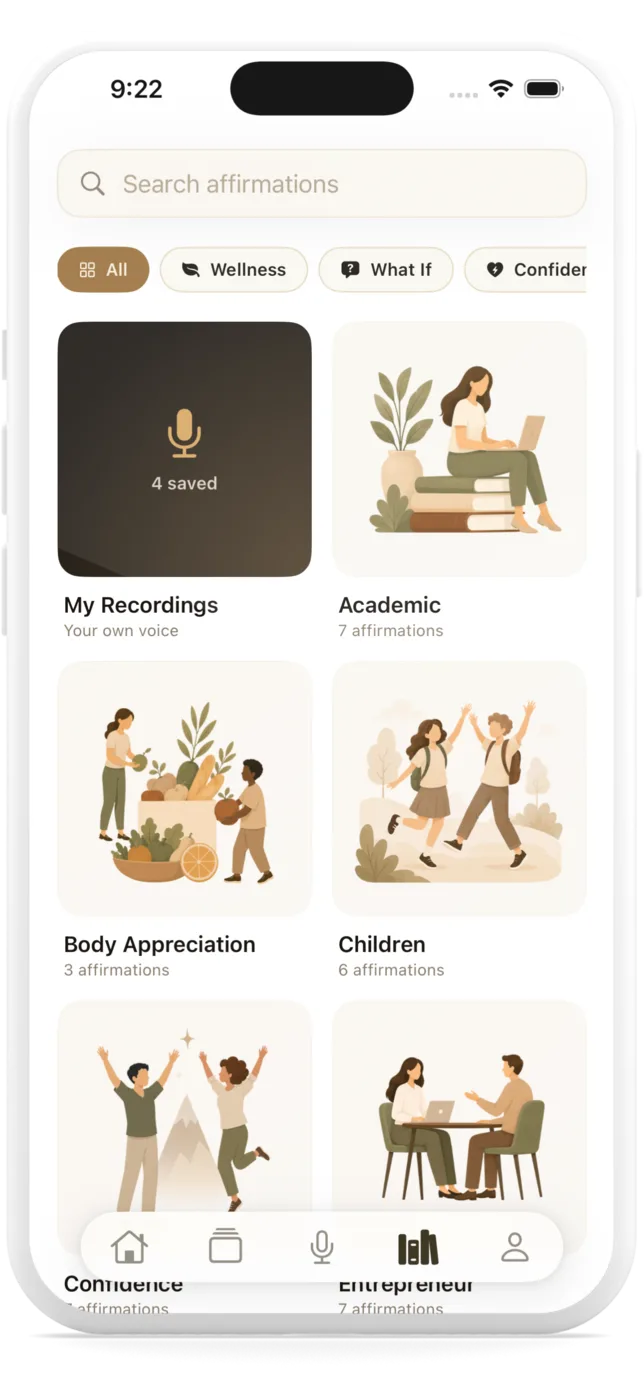
Step 4: Record and replay. This is where an app like Selfpause becomes invaluable. Record your performance affirmations in your own voice and listen to them before high-stakes moments. The combination of familiarity (your own voice) and repetition (hearing it daily) accelerates the rewiring process.
The Compound Effect on Your Career
Self-talk doesn't just affect individual moments — it shapes your entire trajectory. People who consistently practice positive self-talk take on bigger challenges, recover faster from setbacks, and project the kind of confidence that opens doors.
The voice in your head is the one voice you hear more than any other. Make sure it's saying something worth listening to.
Ready to start your affirmation practice?
Download Selfpause and begin transforming your mindset today.
Get Started Free